
- Difficulty monetizing classifieds led move into digital retail
- Expansion into EVs, warranties, inspections and financing
- WhatsApp sales tool could work for other marketplaces
Africa is a compelling secondhand automotive market, both for its huge potential — rapid GDP growth, urbanization, booming internet connectivity and a fast-growing middle class — but also for the valuable insights it offers other marketplaces.
Some 95% of the automotive market in the continent is made up of used cars, and 95% is informal, which means vast untapped potential. But the right approach is crucial.
’Listings didn’t equal transactions’
“People often say classifieds don’t work in Africa — or at least Sub-Saharan Africa,” said Axel Peyriere, CEO and co-founder of digital used-car retailer Auto24.Africa.
Speaking at the AIM Group’s AutosBuzz conference in Berlin in May, Peyriere characterized the market he first discovered as “parking lots full of cars — some good, many bad. There was no financing, no warranty, no paperwork. It was mostly cash-based and trust-based, peer-to-peer. There was no digital platform.”
So Peyriere and CFO Fredrik Orrenius founded Africar Group in 2016 “to bring trust and transparency to used-car transactions in Africa, to make them simple.”
The company launched a listings platform — “frugally, with no funding” — for people to post cars online, across more than 40 sub-Saharan African countries.
“The problem was that listings didn’t equal transactions,” Peyriere said. “We had strong lead generation, but low conversion. Customers want simplicity, confidence, and security — like warranties, returns, delivery, financing, all in the local language, mobile-first, with human support. Africa is a mobile-first continent.”
Achieving reach was relatively straightforward. With 50 platforms, Africar Group was No. 1 in sub-Saharan Africa — “not because we beat big competitors, but because no one was really there,” he acknowledged. “Traffic was great, but monetization was poor. Advertising was hard. Eventually, we pivoted from listings to transactions — but that required capital.”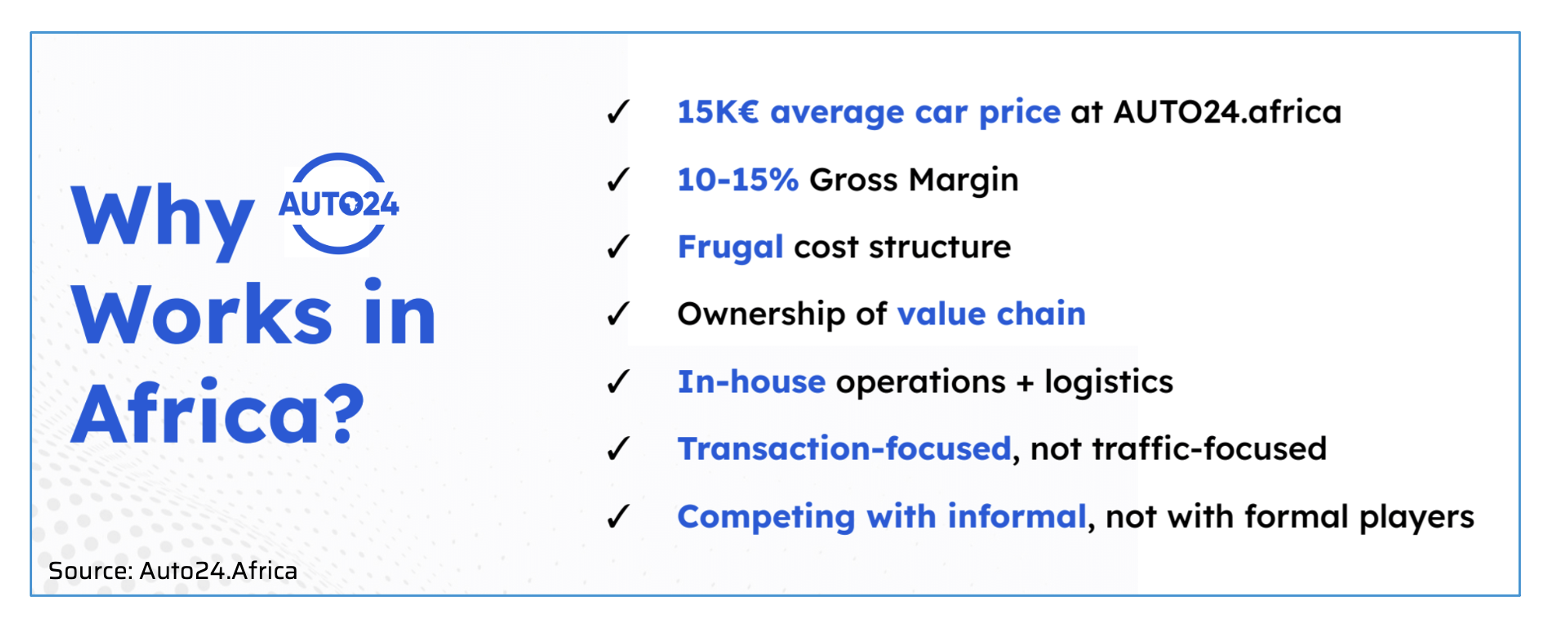
From classifieds to sales product
In 2022, backed by giant auto manufacturer Stellantis (Peugeot, Citroën, Fiat, Jeep, Chrysler and others), Australia-registered Africar entered digital retail through Auto24.Africa, with its initial launch in Cote d’Ivoire.
The company then expanded this model — to buy, recondition, and sell cars, using buyer and seller leads from its classified business — to Morocco, Rwanda, Senegal and South Africa. There are several digital retailers operating on the continent, including WeBuyCars in South Africa and Sylndr in Egypt, but Auto24.Africa is the first to do it at wide scale.
It now offers warranties (six, 12, 24 months), verified documents, customer support, inspection points, and even financing. Peyriere describes the business as “mostly digital with a human touch — 95% of the process is online, 5% offline.”
20 local agents
The company uses 20 local agents, across five countries, and 30,000 square meters of premises. “In Africa, logos don’t close deals. Relationships and trust do,” he said.
It sells cars for around €15,000 ($15,400 U.S.), an affordable price point for Africa’s middle class. A frugal cost structure gives the company a 50% gross margin.
“That’s been our strength: managing without much capital. Now, we’re learning how to manage with more,” Peyriere said.
“We own the full value chain — operations, logistics — and we compete mainly with the informal sector, not formal players. In South Africa, we do face formal competitors (like WeBuyCars), but we aim to be a mid-sized player, not the biggest. In other markets like Morocco, our competition is mostly informal, so we focus on gaining share from that. We also work with platforms like Cars.co.za — many formal players don’t collaborate with digital channels, which gives us an edge.”
The company has built its own tech stack, with a team based in Nepal. It has created b-to-b trading platforms, leasing and subscription tools, and rent-to-own models, which are popular locally.
In March 2025, in keeping with investor Stellantis’ transition from a traditional car company to a sustainable mobility tech company, it launched Africa’s first electric vehicle (EV) marketplace, EV24.Africa, to sell both new and certified secondhand electric vehicles.
EV24.Africa is a transactional marketplace, managing vetted suppliers and simplifying the buying process from discovery to delivery, according to Peyriere. By July, the company reported its first deliveries of EVs.
“Users can compare models, request quotes, apply for financing, get country-specific import guidance, and manage the purchase process entirely online. We’re also integrating tools for after-sales support, including service and maintenance scheduling, and access to EV charging infrastructure information in select countries,” he told the AIM Group recently.
“We’re building a full-stack mobility platform for Africa,” he said at AutosBuzz. “It’s ambitious, but it’s an opportunity. We are pan-African, adapting our approach to 54 different markets and cultures. …
“Our strategic partner Stellantis lets us operate independently and with multiple brands. They also use us to launch products like Leapmotor, a Chinese EV brand they’ve partnered with globally. We’re their landing pad in Africa.”
The company has grown from a $100,000 classified business to a $50 million operation in five countries in just three years.
Its goal is to be the No. 1 pan-African mobility marketplace, in more than 20 countries, selling 100,000 cars annually, by 2030. It’s currently selling around 8,000 to 10,000 per year. 
Africa: A ‘blueprint for frontier markets’
The nature of the African market, a mobile-first space with low costs, can yield important learnings. Companies should go beyond Classifieds 1.0, and adaptation beats replication — each market needs a tailored approach, urged Peyriere.
“Africa is a blueprint for frontier markets. We draw inspiration from LatAm players (like Kavak) and Asian ones (Carsome, Carro). But we’ve developed a localized, human-centered model. Trust, logistics, and financing are the winning trio,” he told AutosBuzz.
The trust issues on the African market are underscored by the recent scandal at Prosus-owned AutoTrader.co.za — the leading auto marketplace in South Africa — which in May reportedly launched an internal investigation over claims employees had colluded with dealers to provide them with an undue advantage in accessing private customer vehicle listings in return for bribes.
As well as assuring trust and transparency, Peyriere also believes it’s important to own the full user journey. He sees a future characterized by mobility as a service, embedded finance, smart logistics, and EVs.
Shift to transactions is growing
Imad Hammad, founder and CEO of UAE-based CarSwitch, sees Auto24 as part of a global trend.
“Auto24’s pivot to a full-stack transactional model is not unique to Africa — rather part of a broader pattern we’ve seen across emerging and mature markets alike. The real challenge isn’t that classifieds ‘don’t work’ for consumers — they often do. The problem is that pure classifieds are hard to monetize sustainably, especially in low-trust or under-digitized environments,” he told the AIM Group.
“As a result, many platforms have moved closer to the transaction in search of durable revenue models. Some take the full leap — vertically integrating, acquiring inventory, and operating like digital dealerships. Others remain asset-light but build monetizable services around key pain points in the user journey — inspections, financing, warranties, aftersales, etc. There isn’t a single blueprint — but the common principle is clear: Follow the user journey, identify pain points, and solve them in a way that adds value and captures margin.”
No legacy issues may drive innovation
Viktor Alekseev, the primary founder of Barcelona-based auto tech company YPV, agrees Auto24 is on the right path.
“As many other segments have shown, including fintech, not having the legacy ssues may lead to innovations in any sector,” he told the AIM Group.
“Automotive transactional marketplaces will not be an exception. Africa is very much a used-vehicle continent, but we also believe that as economies grow, there is a space for a pan-African new-vehicle marketplace, saving distribution costs which legacy dealership networks currently inherit on the other continents.”
Working WhatsApp for sales
One of Auto24.Africa’s biggest sales channels is WhatsApp, which generates up to 20% of sales, with the help of Message Plus, in a collaboration that began last October.
Paris-based Message Plus calls itself a one-stop-shop for WhatsApp business messaging, covering commerce, customer support, and marketing broadcasts, all on one platform. A business can use its system to run outbound campaigns, connect live with customers and replace phone and email support, CEO Benoit Dureisseix told the AIM Group.
Message Plus’s technology uses WhatsApp as a communication channel to connect users — those wishing to buy or sell a car — with sales reps. Everything is automated.
“We create multiple WhatsApp entry points across the customer journey. For example, we embed a WhatsApp button on the website. Instead of sending an email or calling, users can click the button and instantly start a conversation on WhatsApp,” said Benoit.
The tech also links WhatsApp to Google Ads and Instagram. If someone is scrolling through Instagram and sees an ad — “Find your next car with us” — they can click and start a WhatsApp chat. The AI prescreens them, asking such questions as: What kind of car are you looking for? What’s yourbudget? Do you need financing? This helps the sales rep receive a fully qualified lead with all the information needed to follow up efficiently.
During prescreening, Message Plus also captures WhatsApp opt-ins, so the company can send outbound marketing campaigns directly to users.
WhatsApp brings high open rates
This type of marketing can be far more effective than traditional digital communication channels, Dureisseix told us: On average, email open rates hover around 15% to 20%, while WhatsApp generates open rates of above 90%, as well as significantly higher click-through rates.
Since launching with Auto24.Africa, Message Plus has been generating around 17,000 leads per month, as well as collecting 30,000 WhatsApp opt-ins and sending around 30,000 broadcasts each month. Auto24.Africa began by spending €2,500 / month ($2,785 U.S.) with Message Plus and has already tripled that in response to the results. Message Plus plans to expand to other automotive clients, and then beyond.
Message Plus, which has developed all its technology in-house, is also rolling out AI agents. When Dureisseix spoke to the AIM Group, the company was poised to launch bots capable of helping people buy and sell cars on WhatsApp, completely autonomously. For example, if a user types, “I’m looking for a Mini Cooper under €20,000,” the AI can search the inventory, recommend a match, and even book a test drive — all without human intervention, he said.
“At the moment, no one else is doing this in the automotive space the way we are. That may change now that Meta is enabling WhatsApp monetization, but currently, we’re the only WhatsApp-centric platform helping marketplaces turn WhatsApp users into buyers,” said Dureisseix.
100,000 units by 2030
South Africa-based Cars.co.za, Dubai-based autotech company Seez, and Saltside Technologies-owned Bikroy (Bangladesh) and Ikman (Sri Lanka) have all also integrated WhatsApp to enable direct communication between users and sellers or dealers.
Auto24.Africa’s objective is to sell 100,000 cars annually by 2030. It’s a lofty goal, but at a low unit price point and potentially servicing a continent of 1.5 billion people, it’s possible. Carvana, the U.S.-based digital retailer, sells around 400,000 units annually in a nation of 340 million people.
With many historical marketplace failures, particularly when it comes to pan-African models, the auto vertical will hope to break the mold and scale successfully to unlock the region’s full huge potential.
