
Auto sites must harness GenAI and reposition themselves to cover the full car-buying journey, while implementing new business models that do not sacrifice their independence, if they are to stay relevant in an auto market entirely transformed by AI.
The advice comes in a new report from Boston Consulting Group (BCG) and ChatGPT developer OpenAI, which poses the question: Will AI become the best car sales advisor?
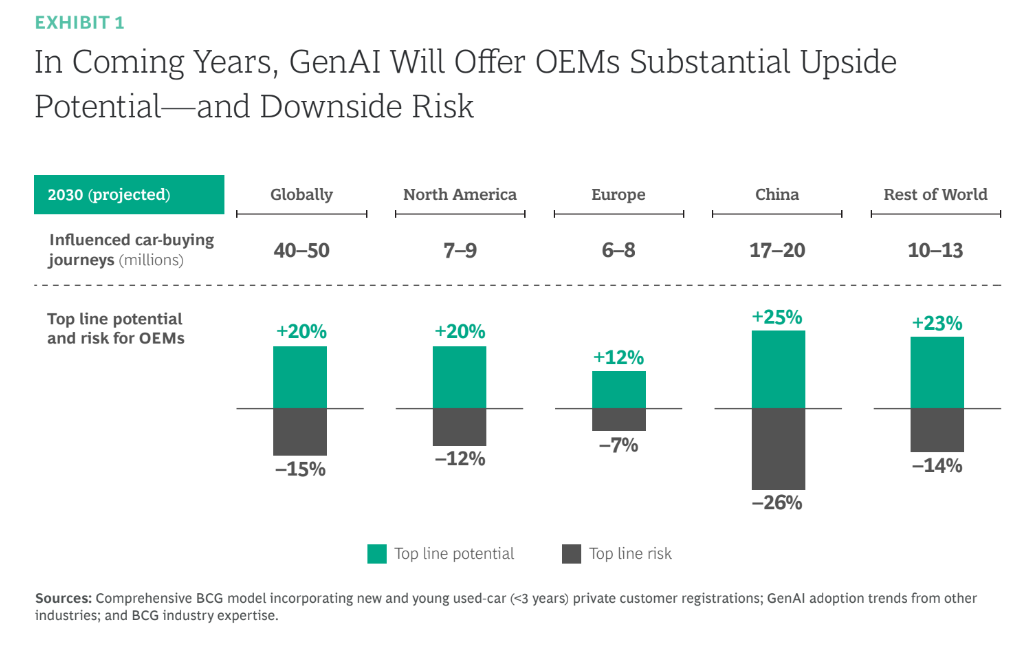
The report reveals that the companies’ detailed model suggests that by 2030, more than 40 million car-buying journeys of private customers worldwide every year will be “meaningfully influenced” by GenAI.
“Online car marketplaces must become GenAI-powered advisors, offering seamless, end-to-end, GenAI-native consumer journeys combining vehicles, insurance, home charging, and mobility subscriptions to position themselves as true one-stop ecosystems. The key is not just to compile accurate data but also to infuse it with meaning and context that enables a superior car-buying journey,” wrote the report authors.
“In doing so, they must figure out how to balance maintaining their perceived independence as a trusted, objective advisor with the need to find new monetization models, such as partnering with OEMs and third parties, including leasing companies and banks. In e-commerce, platforms that tilted too far toward vendor-sponsored placements lost consumer credibility. The same risk applies here: if consumers lose trust in an advisor’s objectivity, they will turn to others for advice.”
BCG and OpenAI share the conclusions of the AIM Group’s recent webinar, AI Personal Assistants: Ally or Enemy for Auto Marketplaces? — in collaboration with digital customer engagement specialist Kaisa — that car-buying will be revolutionized by the advent of AI.
Car shoppers aren’t keen on many of the steps in the consumer journey.
The BCG and OpenAI report comments that “many customers find both the offline and online car-buying experience fragmented, opaque, and frustrating. According to a recent BCG consumer survey, almost half of respondents who have recently purchased a car were dissatisfied with the experience.”
So the sector is ripe for disruption.
“GenAI has the potential to transform the car-buying experience,” wrote the two companies. “GenAI will fundamentally empower how consumers discover, evaluate, and commit to life’s biggest purchases — not with clicks, forms, or phone calls, but with natural conversations that truly understand all the nuances of a customer’s needs.”
The report underlines how AI technology is poised to remove several of the oft-bemoaned pain points in vehicle shopping.

Both graphics from BCG and OpenAI report
“Successful transformation will turn a once-fragmented, complex experience into a seamless journey — one that feels as effortless and personal as talking to a friend,” it stated. “It’s a reimagining of trust, simplicity, and personalization in the car-buying experience, powered by GenAI.”
The report describes how today’s car-shoppers are left “navigating a maze of websites, dealerships, financing options, and endless trade-offs. There is no neutral, multidimensional advisor that consumers can consult on their purchase. No online platform filter allows consumers to enter anything about their driving patterns, design preferences, luggage needs, or charging infrastructure at home and work.”
BCG research suggests that many vehicle shoppers would be “willing to pay more in exchange for a simpler, more transparent purchasing experience without the need to compare prices for the same model or engage in negotiation.”
Being able to skip this painful part of the process would be a boon for car shoppers.
“Every second customer finds comparing and negotiating prices to be the single most annoying step in the customer journey; when given the choice, most consumers prefer not to bargain at all,” noted the report.
AI can help personalize the process. Individual car buyers have a complex mix of personal needs, habits, and priorities that static online tools can’t capture.
“This makes the car-buying experience well-positioned for transformation by GenAI in terms of both customer experience and commercial impact. For consumers, buying their next car will become as easy as telling their story,” added the authors.
GenAI-powered assistants could narrow down models, clearly explain the trade-offs, and even schedule test drives and generate pre-filled financing options, and offer real-time, unbiased recommendations across brands and prices.
The report’s authors were Andrej Levin, Robin Wagner, and Ferdinand Harries of BCG, and Michal Bednarczyk, Shikhar Kwatra, and Philipp Eulenberg of OpenAI.
