
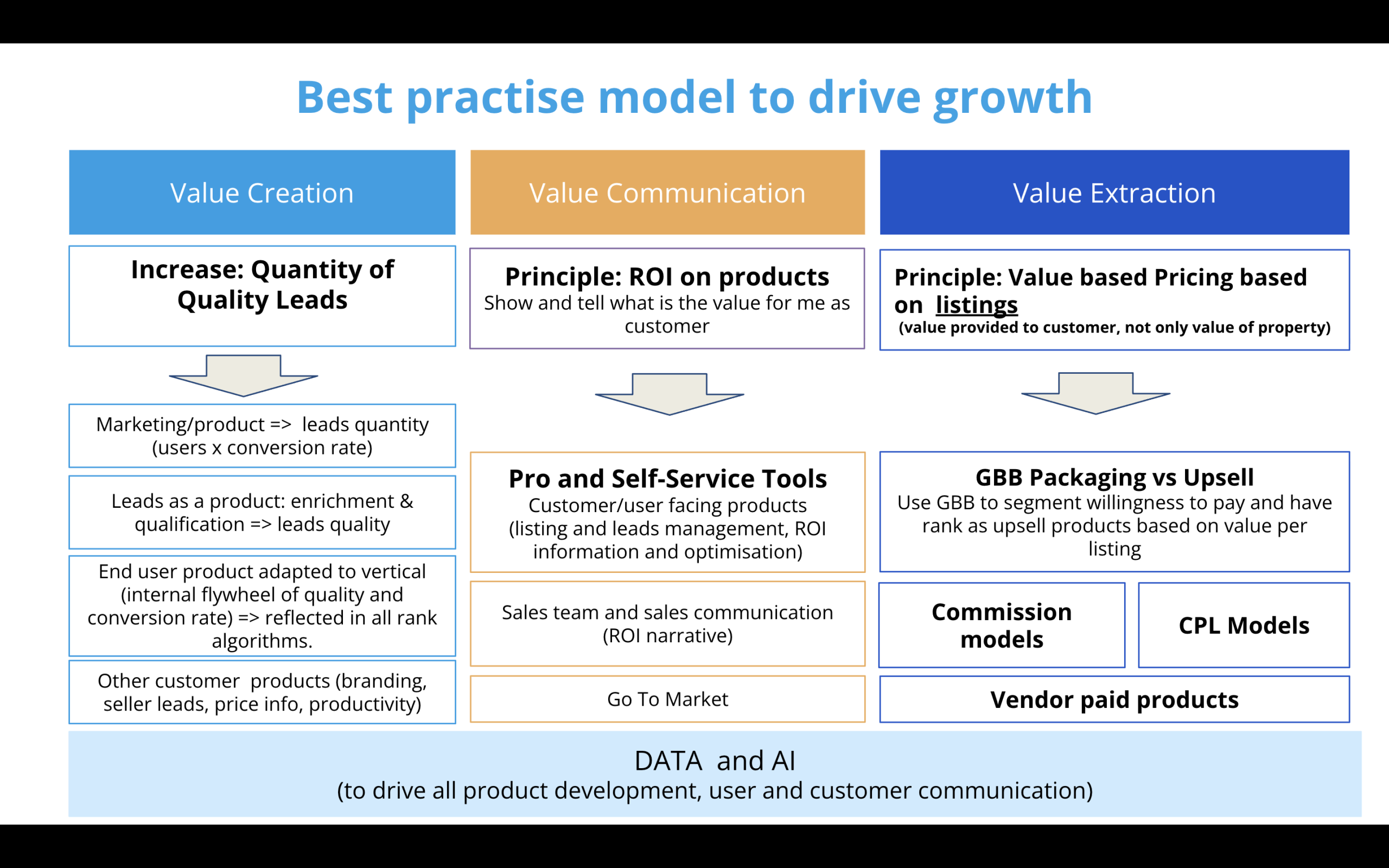
Source: Frode Nordseth
“Finn.no and other real estate marketplaces have not evolved much in terms of thinking about customer value and how they communicate the value they bring, since we copied the business model from the newspapers,” according to classifieds industry veteran Frode Nordseth.
A former Norwegian Navy officer, Nordseth joined Schibsted in 1999 and was part of a team of four that ran marketplace horizontal Finn.no in its earliest days. Later, he was CEO of Schibsted’s marketplace business in Spain for a number of years.
Now based in Dubai, he describes himself on LinkedIn as a “strategic advisor for classified and marketplaces… expert on digital business models and profitable scaling.”

Frode Nordseth
“The problem seems to be a lack of focus on the value they [marketplaces] provide to customers. I have spent time on ‘value-based monetization,’ and it seems that Finn has not evolved a lot in terms of thinking about customer value, since we copied the business model from the newspapers. When you do not focus on the value the customer receives, it very easily turns into discussions about price, especially price increases, which has created an opening for Hjem.no, the new rival to Finn in Norway,” Nordseth told the AIM Group.
“It is very difficult to believe that the brokers behind Hjem started it to provide sellers with a better service: It is obvious that this is a fight for who will ‘earn’ more money on a home sale. Hemnet in Sweden is in a similar situation. I think both Finn and Hemnet need to focus more on documenting the effect (i.e. value) for both the home seller and the real estate agent.”
“When they have to document value, product development and business, models will also change towards driving more value. They have lived in a ‘monopoly bubble’ for too long. In markets where there is real competition, the players have started to focus more on ROI — but still not enough in my opinion. Finn and Hemnet are behind the curve, based on the signals I have received from the industry.”
Nordseth has developed a methodology he describes as “Value creation — value communication — value extraction.” “Those who win the market combine these three, he argues.
“Because first, it is the seller who pays, which means that the real estate agency does not have the same need to document value (value for the agent can differ from value for the seller). In Norway, people show up for open house viewings, but there is little willingness to document the correlation between the ad and who shows up for viewings and who ends up buying a home and the price the seller gets.”
“This means that you cannot show the impact of an ad at Finn? Yes! I recently saw that there was a broker who complained a lot that a marketplace had increased the price of the ‘ad of the week,’ thinking only of the price percentage increase. But I have seen documentation from other portals that this kind of ad of the week drove 5,700% more leads compared to an ordinary ad for the same kind of object. So, the price might not be high enough to reflect the real value of the ad. In fact, the ad was very undervalued: It should have been 5,700% higher than an ordinary ad.”
For many marketplaces, it’s still just a question of selling visibility (rank and size), the number of pictures, maps, and some area information, Nordseth said, arguing that it remains largely the same concept that the newspaper industry created in the 20th century.
“Very few marketplaces have developed models where pricing reflects the actual value they provide through their products,” he said, adding that “The ultimate model would be to move toward a commission-based structure, but that is not easy to implement on a real estate portal — and probably not the right approach for now.”
“It is very important to have different models for different verticals: Real estate for sale is different than rentals; new housing needs a completely different business model than housing for sale,” according to Nordseth.
“You can probably increase prices much more if you document the effects of the ad”
“During the print age, there was no information on who read what. On a digital marketplace, it is different. Even if it has extremely good data, that data is not used to create new business models. You can probably increase prices much more if you document the effects of the ad. That is my point.”
“Our product is leads, but we are selling visibility. So, we have a great mismatch between what we try to sell to what customers expect to get. The customer wants quality leads that can lead to a sale, but the number of marketplaces that have products where you can follow the leads to a final sale is very few. Which is, of course, scary, as quality leads is what the customer really wants to buy.”
“But many marketplaces do not even think of leads as a product. We even send leads to advertisers without following up on what happens with them. If you develop systems where you can follow the journey of leads, you can start to track the quality of the person or company that is receiving that lead and avoid sending high-quality leads to agents/agencies that deliver a poor service to the end user.”
“This is a huge problem outside the Nordics, where companies spend millions to get leads but never respond to them. When you start to work on value creation, you have to be able to communicate that to the customer.”
“We as an industry have completely underestimated the need to communicate the value we give to our customers. We have sold them visibility, and that is what the customer gets. But then every time you want to increase the price, you get a massive uproar from the customers.”
Besides being a consultant, Nordseth is also the co-founder and strategy lead for Your Bazaar, a general goods marketplace in the UAE. He will be appearing on a panel at the Property Portal Watch conference in Madrid later this month.
The AIM Group contacted Christian Printzell Halvorsen, CEO of Vend Marketplaces (formerly Schibsted Marketplaces) — which operates Finn.no — but he replied that he had no comment on the matter.
